Sometimes called Thai boxing, this martial art was developed for the military in the 16th century. This art allowed Thai people to repel the Burmese people during invasions. Today, Thai boxing is practiced all over the world by people of all ages and levels. This art, so-called dangerous art, is derived from Krabi Krabong which, like Thai boxing, requires physical skills such as flexibility, reflexes, power and strenght, but also mental skills as respect. Thai boxing is considered a national sport in Thailand. Many small training clubs (called camps) are spread throughout the country and welcome young boys from the age of seven. Important fights are regularly broadcasted every saturday and sunday on TV channels. The two most popular stadium of Bangkok, where the fights take place, are the Lumpinee and the Rajadamnoen. These places are known all over the world and are considered a reference in the Muay Thai world. The Lumpinee stadium is located on Rama 4th Road, near the Lumpinee park and the Rajadamnoen stadium is located on Rajadamnoen Nok Road in front of the headquarter of The Royal Thai Army.
A fight takes place in 5 rounds of 3 minutes each. It is preceded by a ritual dance: The Ram Muay during which the Nak Muay (the fighter) wears the Mongkon ( a piece of fabric he wears around his head to manifest the respect due to his trainer and to optimize his mental perception). This dance is composed of codified gestures, performed by both oponents individually and which are specific to each training club. A small orchestra composed of a drum, a cymbal, a nasillarde flute punctuates the rounds.
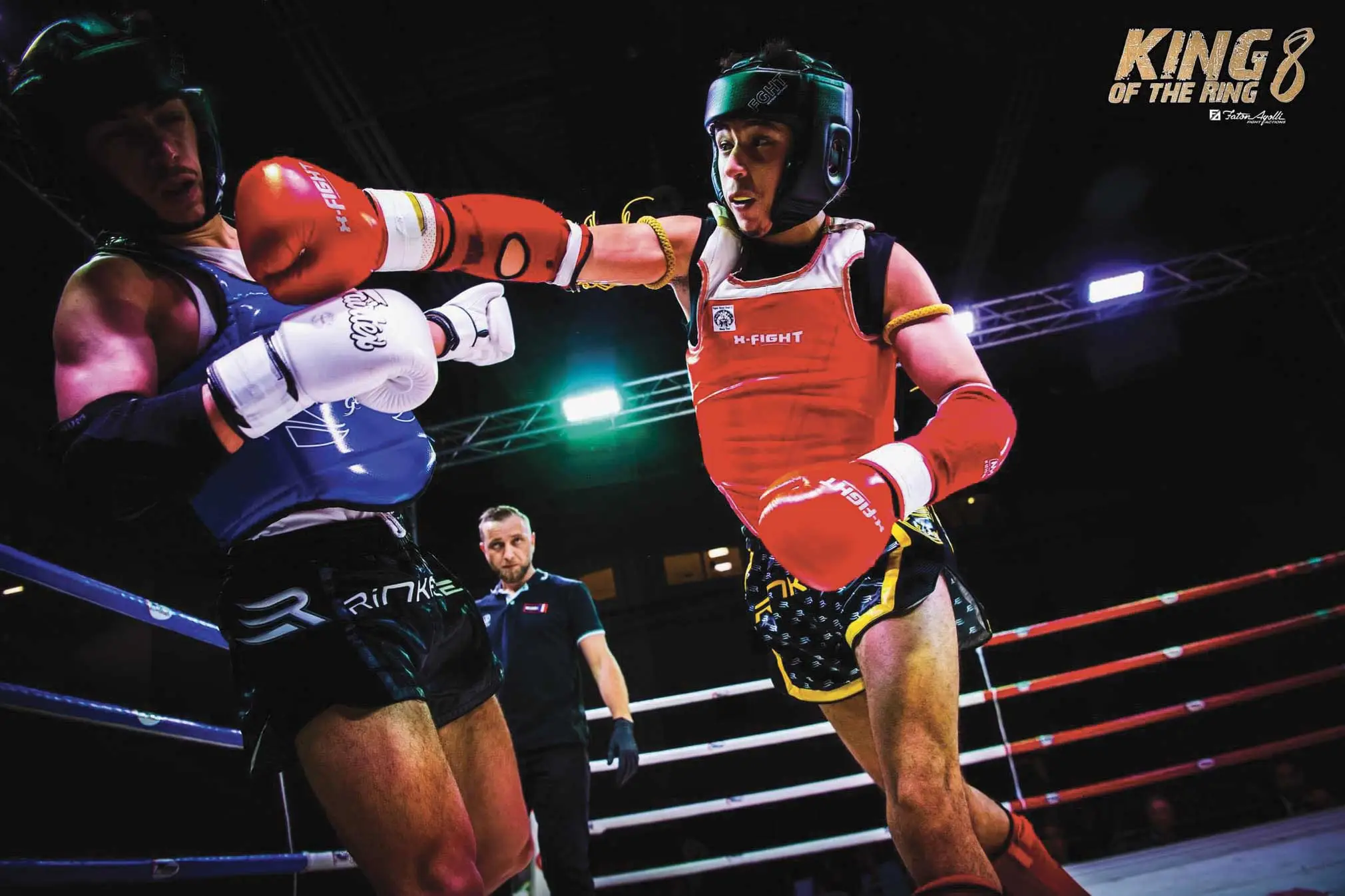
Strikes allowed are: punches, elbows, knees, kicks. The hand-to-hand combat can last and gives opportunities of knee strikes, they can end by knocking down the opponent or be interrupted by the referee. The use of elbows is rare in most Thai boxing fights outside Thailand. The most commonly used kicks are the circular shin kicks, which are the "basic move" of the Thai boxer. Televisions around the world broadcast the big Muay Thai fights especially the spectacular K-1 in Japan with its 20,000 spectators and awards of over $200,000. [Source Wikipedia]
Muay Korat is named after the place where the style originated; Nakhon Ratchasima which is located in the center of Thailand towards the east. The style of Muay Korat appears to the public around the time of King Rama IV, but perhaps the Korat people have had this style for more than a thousand years.
The governor of the city of Nakhon Ratchasima, Phra Hemsamahan was since we know the transmitter of Muay Korat. Phra Hensamahan teach the style to Deng Thaiprasert who became the first fighter to represent the Korat style fighting in front of the King, and winning the competition acquiring the title of “Muan Changwat Cherng Chok”, meaning “The King’s Champion”.
Another student of the art, taught by Phra Hemsamahan, was Kruu Bua Wathim. This is considered the real master of the Muay Korat system. Kru Bua became a soldier and taught cadets in the Army all his life. His name was Kru Bua Ninarcha, and his nick name “The Black Horse”.
Muay Korat is considered to be the Muay Thai of the East.
The stance in Muay Korat is quite different from other styles. The stance is quite long and very narrow with both feet almost in one line, both pointing forward. The hands are placed one in front of the other, lined up together in front of the nose. The front, or lead leg is straight and the knee is locked. The back leg is also straight, tensed and ready to kick upwards, or to use footwork to change the angle against the opponent. The back leg heel is also up off the floor. The body’s center of gravity is close to the front leg with the head positioned over the front foot, body leaning forward.
This style of Muay Thai prefers to attack or intercept an attack by simultaneous block and strike, or sometimes choose to lock or throw the opponent to the floor. Rarely does the Korat style teach students to block and then attack. The kind of footwork used is “Suua Yang”, which means “Tiger Walk”. These techniques are closely guarded. One of the most powerful weapon in Muay Korat is called “Viang Kwai”, means “Swing of the Buffalo”. This technique is executed after a kick and uses the knuckles in a circular way to strike the opponent behind the ear. Another famous attack is called “Taa Krut” which is used as a counter-attack, launching two strikes simultaneously.
Meditation was a very important part of their training, followed by a strong respect for seniors and the golden rule of not to fight in the ring with other Muay Korat boxers.
We start with the Wai Khru, which is the first part of the ritual that the Nak Muay performs when entering the ring. Much of the Thai vocabulary comes from Sanskrit, the literary language of ancient India. The term "Wai Khru" is no exception. Wai Khru literally comes from: Wai: tribute, greeting; and Khru: master, teacher, mentor.
Initially, it reflects the gratitude of all boxers to their parents, coaches and all the people they respect. The Nak Muay not only pays tribute to its master, but also to all those who hold the knowledge of the discipline.
The Wai Khru begins after entering the ring. When the boxer goes around the ring bowing respectfully and touching the four corners three times, he pays tribute to his master and his parents (one punch for each person, or if the parents count as an entity, the last punch symbolizes the audience that came to see him fight). Historically, the reason for the fighter to go around the ring before the fight was a somewhat esoteric explanation.
In fact, the ring being considered a dangerous place, the fighter was going to spread his etheric body (aura) on the whole fighting surface in order to better tame it and even appropriate it. By doing this, the fighter would engage in a kind of "reconnaissance of the field".
By this ritual, no place in the ring would become a refuge for his opponent.
It is astonishing to note that we find today a very strong analogy between these gestures and the unconscious habits that many human beings observe in their everyday life (for example: when we go for the first time to a place such as a restaurant, a cinema etc... and that the experience of this place is memorized as positive, there is a strong chance that we will position ourselves in the same place if we are led to return to these places).
The same attitude is found in the animal kingdom, where animals often make a reconnaissance tour of the field before lying down. In the past the winner would perform a Wai Khru again at the end of the fight to show his joy. Nowadays, this is no longer done.
Kneeling in the center of the ring for the second part of the Wai Khru, the Nak Muay paid tribute to the "elders" by bowing to the ground, and to the king by looking up to the sky. Today, for most of the Nak Muay, the historical meaning of these gestures has disappeared. These gestures are more executed by mimicry. There is no religious significance to these gestures.In spite of the crouching position and joined hands of the boxer, there is nothing religious about it.
It is a rite in tribute to those who teach, a mark of respect. That is why the term Wai Khru should be translated as "greeting to the master" and not as "prayer". The Wai Khru ends when the boxer gets up from the center of the ring.It is then that he begins his Ram Muay. The Ram Muay : tribute to the public. The Ram Muay comes from : Ram: dance; and Muay: boxing.
Taught only to fighters, it is comparable to a "dance" which by its symbolism calls upon one or several particular legendary figures (for example Hanuman) of the Ramakien, or history of Rama, and the various elements constituting the earth.